Are you planning to pick up a paintbrush at your summer house?

Many vacation home owners inherit vacation homes that look like cigar boxes, and Kresten from Malgodt.dk can help with the process. He offers great painting tips for both the exterior and interior, explains how to make sure you don’t waste time or money, and explains why you should use wood preservative on the deck.
What’s the most essential thing to invest in when starting a painting project? Is there any area where you absolutely shouldn’t skimp? And where can you save a little?
My answer is, of course, colored by my background. But I’d say that we see a lot of people who’ve tried some cheap, low-quality paint, and they end up having to repaint many more times. And in the end, you haven’t saved anything at all. Outdoors, it’s also about how long the paint lasts without losing its color or fading away completely. My tip is that you might as well do it right from the start, so you don’t end up with paint that doesn’t perform optimally. It’s not a good idea to buy super-cheap, low-quality paint. It simply isn’t worth it.


Are there any specific things to look for when choosing the right high-quality paint?
That’s so hard to answer, because it’s incredibly difficult to navigate as a consumer. The best advice I can give is to find a retailer you trust who can provide products of decent quality. There are, of course, plenty of manufacturers that offer good products, but every now and then you’ll also see good manufacturers produce something that isn’t up to par. So you can’t even always count on the fact that sticking with, say, Jotun, will guarantee a good result. The hardest part about finding good paint is that there aren’t any technical parameters or standards you can use as a guideline.
> It’s not a good idea to buy super-cheap, low-quality paint. It simply isn’t worth it.
So what do you do—is it just a matter of finding a professional who has some experience with the products?
Yes, it’s simply the manufacturers and retailers who determine whether you get a good product. There are many excellent reviews online—for example, Bolius has tested paint for durability and coverage. If you stick to reputable review sites like Bolius or the Danish Consumer Council Tænk, you’re pretty well covered. It can’t be quantified, even though I wish it were—we’d love to be able to say, “If you buy this paint, it’ll always look good,” but unfortunately, that’s just not how it works. We also have to test the products ourselves so we know what they’re like.

A beautiful, refurbished summer house from 1927
- Rørvig, Denmark
- 5 guests · 2 bedrooms
- 882 m to beach
- House · 73 m²
Do you have any painting tips that are always worth following when you’re about to start painting?
First and foremost, you need to figure out what you’re painting. Is it indoors or outdoors, and what material are you painting on? Is it woodwork, previously painted woodwork, or a wall that’s been plastered? Wall, plaster, concrete? Once you know what surface you’re painting on, you can figure out which product to use. When it comes to the actual painting process, there’s a rule of thumb: start from the top. Ceiling, walls, and then woodwork last. The floor comes last, if it needs to be painted or varnished.


What’s the procedure when painting outdoors?
Outdoors, there are two different types of paint: for wood and for brick or stucco. Regardless of which one you’re using, you need to clean off any algae, dirt, or mold so you don’t seal anything in with the paint that could damage the house—because that’s the exact opposite of what we want to achieve.
> You can also get paint that includes a sealer, and you apply it two or three times. That saves you both time and money. In fact, a lot of people use this for vacation homes, where they want to paint the ceiling white to let in more light.
Many vacation home owners take possession of their new vacation home with wood from floor to ceiling. How do you know if the wood has already been treated?
If it’s a surface—this applies to woodwork, ceilings, or walls—indoors, the treatment process changes if it has never been treated before. In that case, you’ll need a primer, and for woodwork, it should be a sealer primer or a primer with a sealing effect. You need to use it because the knots in the wood will show through the paint, resulting in yellow-brown spots. You can also use a paint that contains a sealer primer, and you should apply it two or three times. That saves you both time and money. In fact, a lot of people use this for summer homes, where they want to paint the ceiling white to let in more light.
Brushes and rollers… I suppose there’s a difference there, too?
If you’re painting a summer home with wood paneling on the walls and ceiling, you’ll need a good exterior paintbrush. Then it’s just board by board, and down between the boards. That’s the only right way to do it—unless you have a paint sprayer, of course. It just takes a really long time, so what you can do if there are two of you is buy a reasonably long-haired paint roller where the bristles can reach down between the boards. You spread the paint with the long-nap roller and then go over it with a brush to get brush strokes instead of a roller texture.
> The world of outdoor paint is still a huge jungle, but if you want a single color, you’ll need what’s called full-coverage wood protection.
Can you follow the same steps for outdoor wood?
Yes, at least the part about the long-nap roller. Outdoor wood isn’t always planed, so you won’t be able to see the roller marks. That means you don’t need to go over it with a brush. Unplaned wood is already quite rough, so once you apply the wood protectant, you won’t be able to see the roller texture. If the outdoor wood is planed, though, you’ll still need to grab a brush.
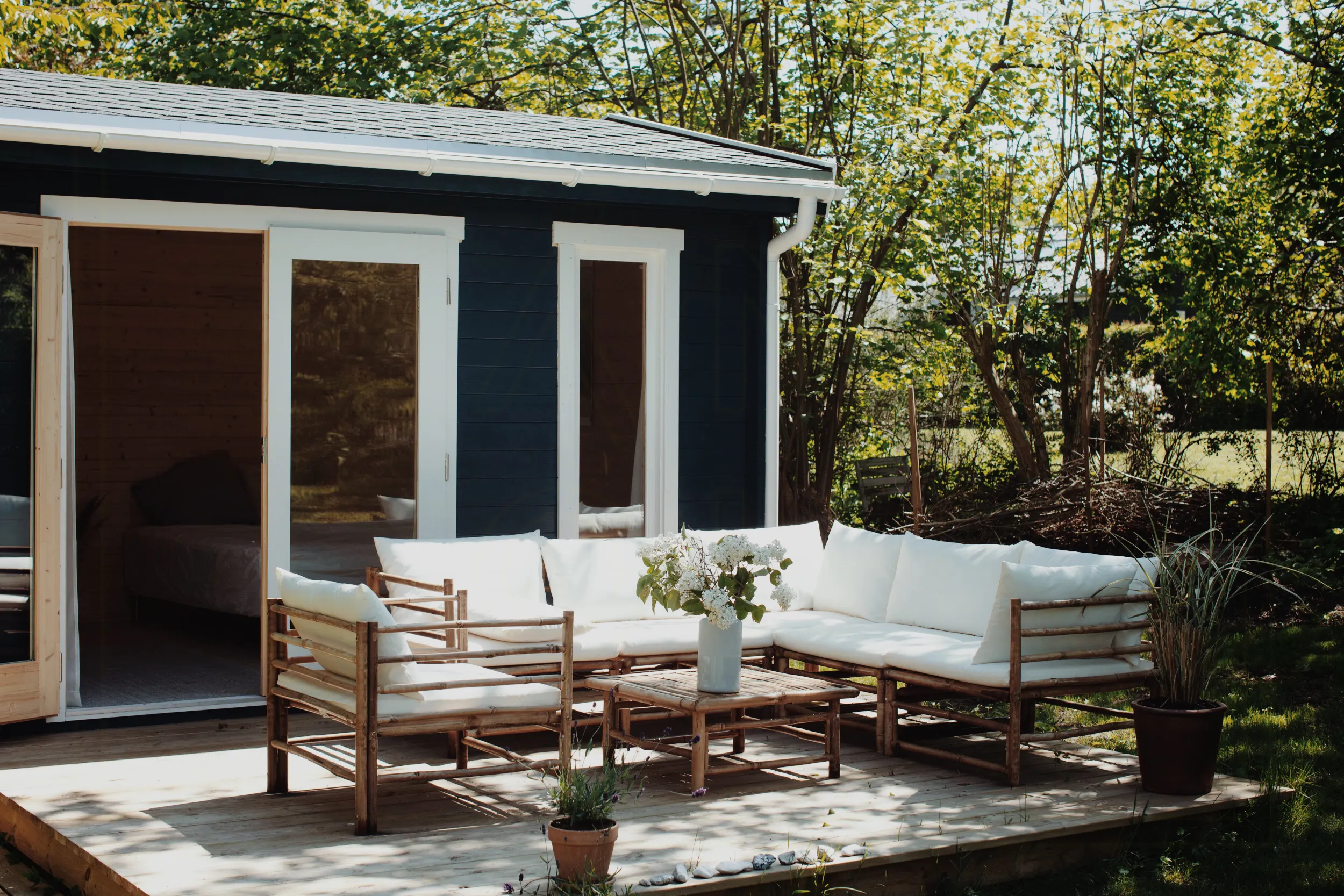

— @rikke.k.b.hald
And of course, it’s tricky to use the same paint indoors and outdoors, isn’t it?
Yes, it is. I’d recommend using paint or wood preservative that’s suitable for the wood. Typically, summer homes are located in areas with a lot of wind, water, sand, and forests, so they’re exposed—especially since summer homes are often built of wood. There’s still a huge variety of outdoor paints out there, but if you want a single color, you’ll need what’s called opaque wood preservative.
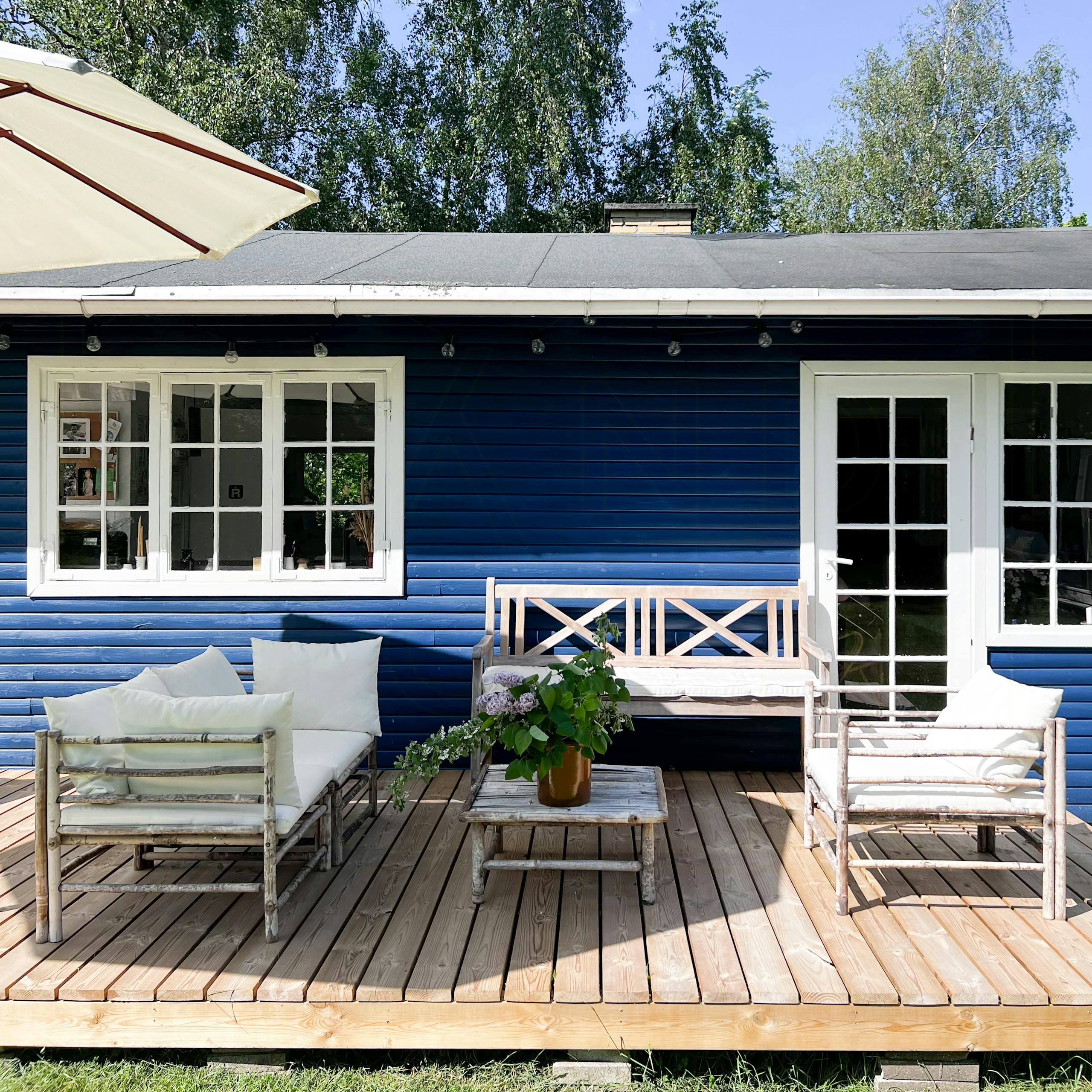
Beautiful and charming blue gem
- Lumsås, Denmark
- 5 guests · 2 bedrooms
- Pets are welcome
- 637 m to beach
What if you just want to treat your outdoor woodwork?
In that case, you’ll want to use wood oil—or alternatively, a transparent wood protectant. The latter offers a tiny bit more durability, but it also forms a surface layer on the wood, whereas wood oil penetrates and becomes part of the wood itself. Wood oil protects the wood by filling its pores, preventing the wood from absorbing either water or dirt. On the other hand, wood oil also evaporates over time, which means it requires more frequent reapplication. But it looks really nice if you maintain it every year. You’ll also only need to use a relatively small amount of oil each time, since you don’t have to treat bone-dry wood.
> You simply must not paint the wooden deck itself, because moisture seeps up from below, and you obviously can’t paint the underside of the deck.
There’s something special about wooden decks. How should you treat them?
A good tip is to ALWAYS use wood oil for wooden decks—never opaque paint or other wood preservatives. You simply must not paint the deck itself, because moisture seeps up from below, and you obviously can’t paint the underside of the deck. This means you can’t completely seal the wood. When it rains, water runs around the wood and is then absorbed into it. When the sun starts shining again, the wood wants to dry out; the water evaporates, and the vapor tries to rise through the paint. It can’t really do that, so the paint will bubble up and crack. It’s incredibly annoying.


Written by Camilla Wegener
September 2021
