Vibeke Panduro on decorating a holiday home on a budget and taking care of what we have
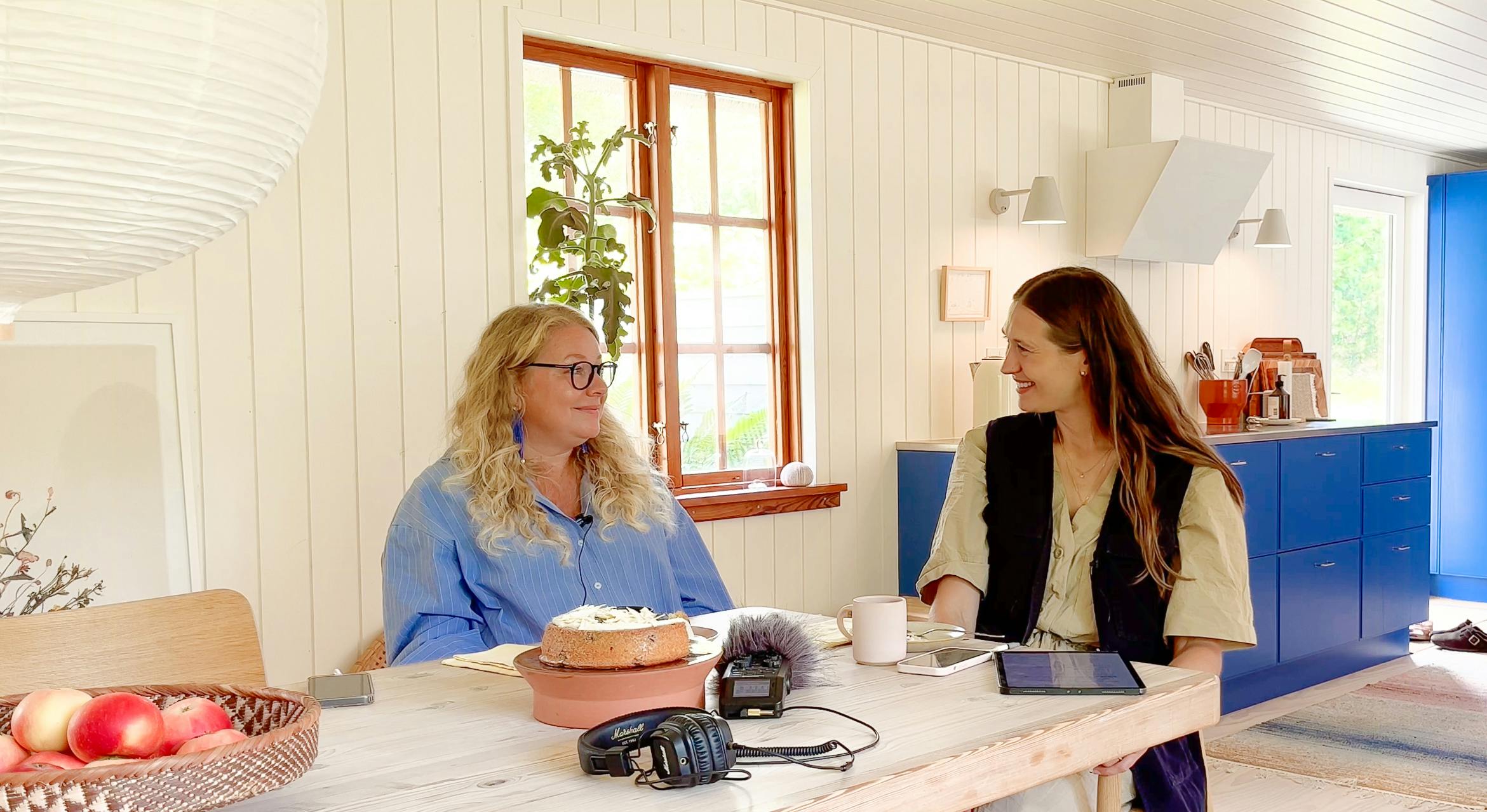
We've had a chat with holiday home owner and interior design enthusiast Vibeke Panduro about her holiday home, Lille Svinkløv, and how she approached its renovation – from mice and wear to a respectfully renovated gem. Read on for tips on renovating in stages and inspiration for preserving the old.
Would you rather listen? Hear the episode with Sussie Frank and Vibeke Panduro from our podcast Sommerhusliv here or wherever you listen to podcasts.
We are sitting in Vibeke Panduro's bright, coastal holiday home in Fjerritslev, Lille Svinkløv. The holiday home bears that name because its architecture, with its thatched roof and delicate, pastel-colored wooden cladding, is a kind of small replica of the old Svinkløv Badehotel located just a few kilometers away.
Each wooden chair around the dining table we are sitting at is slightly different – some of them remnants from when Vibeke Panduro and her husband, Jesper Panduro, took over the holiday home. For many years, the couple ran the Danish design company Skagerak, but after recently selling it, it is her new company, The Table Project, that occupies Vibeke Panduro. That is, when she is not enjoying the beautiful holiday home.


Do you want to experience the holiday home yourself? Book it here.
However, the holiday home Lille Svinkløv has not always been as beautiful as it is now – at least not exactly when the couple took it over.
»I remember we walked around and thought, this has potential. Then we asked the real estate agent, why do you think it hasn't sold? Just wait until you get inside, he said. And it was really gross. It smelled, and there were mice. It had just been standing and was too tired for many years«.
»When we took it over, I had a job that didn't exist during corona, and then I thought, now is the time. So we started painting, clearing out, and driving away. And making it nice and making it ours. So we spent a lot of hours up here painting and cleaning«.
80 liters of white paint
And paint was needed to make the holiday home cozy again. So much so that a total of 80 liters of white paint were used, she says.
»The ceiling isn't super high here. So it had to be bright. And then we needed to get some light in from outside, so we chose to replace a few windows. We wanted to keep the ones that were nice and old. But we replaced a few, partly to create a panorama towards the garden, so you can look at the deer and we got more light in«.

It's super easy to do something if you have all the money in the world. But I actually had a budget that I had to stick to. I had 80,000 kroner to renovate the entire house.
For the renovation, Vibeke Panduro set herself a challenge; she wanted to make the house beautiful and cozy on a limited budget.
»Because Jesper says, it's super easy to do something if you have all the money in the world. But I actually had a budget that I had to stick to. I had 80,000 kroner to renovate the entire house. And that wasn't much, you could say«.
And then she went about it quite systematically:
»We need paint, check. And then we prioritized buying cheap, lightly used furniture over, for example, design, and using some of the ones we had at home that were new. And then we bought a bit of IKEA, some rag rugs, and whatever else we needed to get everything up and running. It was only later that we prioritized doing slightly larger projects like a new kitchen and floor, for example. So we just laid a lot of rag rugs and tried to cover the old floor a bit. But the first round of renovation, we kept it on a pretty tight budget«.

Renovation in budget-friendly stages
»It was a great exercise to feel that you don't have to make everything expensive, and you can renovate and take care of what's already there in that way. And I also think it's about trying to feel what kind of place you are in. And then try to be in it«.
If it's beyond saving because it's from a time when things were built cheaply, then there might be nothing else to do but replace it. But you can live with it for a while and feel it out.
»So it comes in stages a bit,« says Vibeke Panduro.
Since the first renovation on a tight budget, Vibeke Panduro and her husband have completed several stages – including the floor and the kitchen, which she dreamed of making a bold feature in the house. But only after they had lived with the house for a good while and felt what was really important for them to update, and what actually wasn't.
»One thing is how you furnish yourself physically, but another thing is also how you then live in it. I had actually planned for there to be a small staircase up to the upper floor so you would get extra space. But in reality, we didn't need that space at all, we found out. I mean, why should there be space for ten people when there are usually only six of us?«.
»If you calculate it in the end, I have clearly spent more money than the initial budget. In the long run, you get tired of that 90s kitchen, where you fool yourself into thinking you can just change the handles. You can do that for about a year, but then there might come a time when you think, okay. If it's beyond saving because it's from a time when things were built cheaply, then there might be nothing else to do but replace it. But you can live with it for a while and feel it out at least, I think«.


There is no master plan
»It's not like I have a finished plan. That's also part of life. That you feel what needs to happen now, and what can be good for the house. For example, we also had a terrace laid outside, so the outdoor area connects better with the house. That's how it is with a holiday home, things flow together inside and out. But there is no master plan. It's always in motion. I think maybe that's the difference between having a holiday home and your private home. At home, I have more of a master plan for how I think life works best, but up here, it just has to feel good«.
In the couple's previous holiday home, they renovated in a similar way, where the renovation was divided into stages, just even smaller, and thus also with smaller budgets – a nice way to feel that you are taking care of what you have, says Vibeke Panduro:
»In the previous holiday home, for example, we always said, okay, this year the gable window needs to be replaced, and the year after we got a new toilet, and so on, so we have these small items. Then it actually feels quite nice to take care of a house. Because houses, they are just shells that we need to take care of and pass on to the next. I mean, we get to live our lives in these beautiful holiday homes and our homes, but in reality, life is much longer than the time we are here. So we need to take care of the places we have and pass them on nicely to the next. Be sustainable and update what we have, and take care of it«.

Respectful, aesthetic, and bold
Vibeke Panduro is already itching to restore another holiday home gem; a small, fine half-timbered house from 1777 on Bornholm with sea views. And it must be done with respect and love for what is already there, she says:
»You have to take care of the characteristic features. Inside, there was once a cooper's workshop at one end, and at the other end, it has been rented out far too much and is really ugly. The two things must be united, and that can be a difficult exercise«.
»And then, of course, it must be carefully taken care of, and you must use the surroundings that are there, and look at the house. For example, there are some really nice tiles that have been worn through many hundreds of years. You have to take care of them and use them again. So it's very much about looking at the house you are lucky enough to have, and then trying to make the best of it, I think«.
»That is, to furnish respectfully. And then aesthetically and boldly,« if it's up to Vibeke Panduro.

Written by Nina Lykke
April 2023
