Guide: Everything you need to know if you're considering investing in a wilderness bath for your cabin

There are many types of wilderness baths, but what should you really consider before investing in one? Here, cabin owners Manuela and Jesper share their experiences and best advice, and expert Domantas Krumas guides you on how to choose the right wilderness bath for your cabin and your needs – from types and design to maintenance and price.
Would you rather listen to the episode? Listen to the episode “Guide to wilderness baths” from our podcast “Cabin Life” here or wherever you listen to podcasts.
This article is about
- Advice and experiences from cabin owners Jesper and Manuela Basile
- Go on a research trip and get an impression of wilderness baths first
- Choose appearance based on your cabin
- What is your space requirement?
- Internal or external stove
- Wood, fiberglass, or acrylic
- Maintenance of the wilderness bath
- Extra features
- Cleaning and emptying water
- Placement at the cabin
- Price example
Steaming hot water, a starry sky, and the smell of rain-soaked fir trees. A wilderness bath fits particularly well with the fundamental joys of cabin life, where nature is right outside the door and time moves differently than in everyday life.
That's why we've spoken with cabin owners and Landfolk hosts Jesper and Manuela Basile about their considerations when investing in a wilderness bath for their cabin. We've also spoken with Domantas Krumas from Vaido Vildmarksbad about everything from types and maintenance to design and price, so you know everything you need to make the right choice for your cabin.
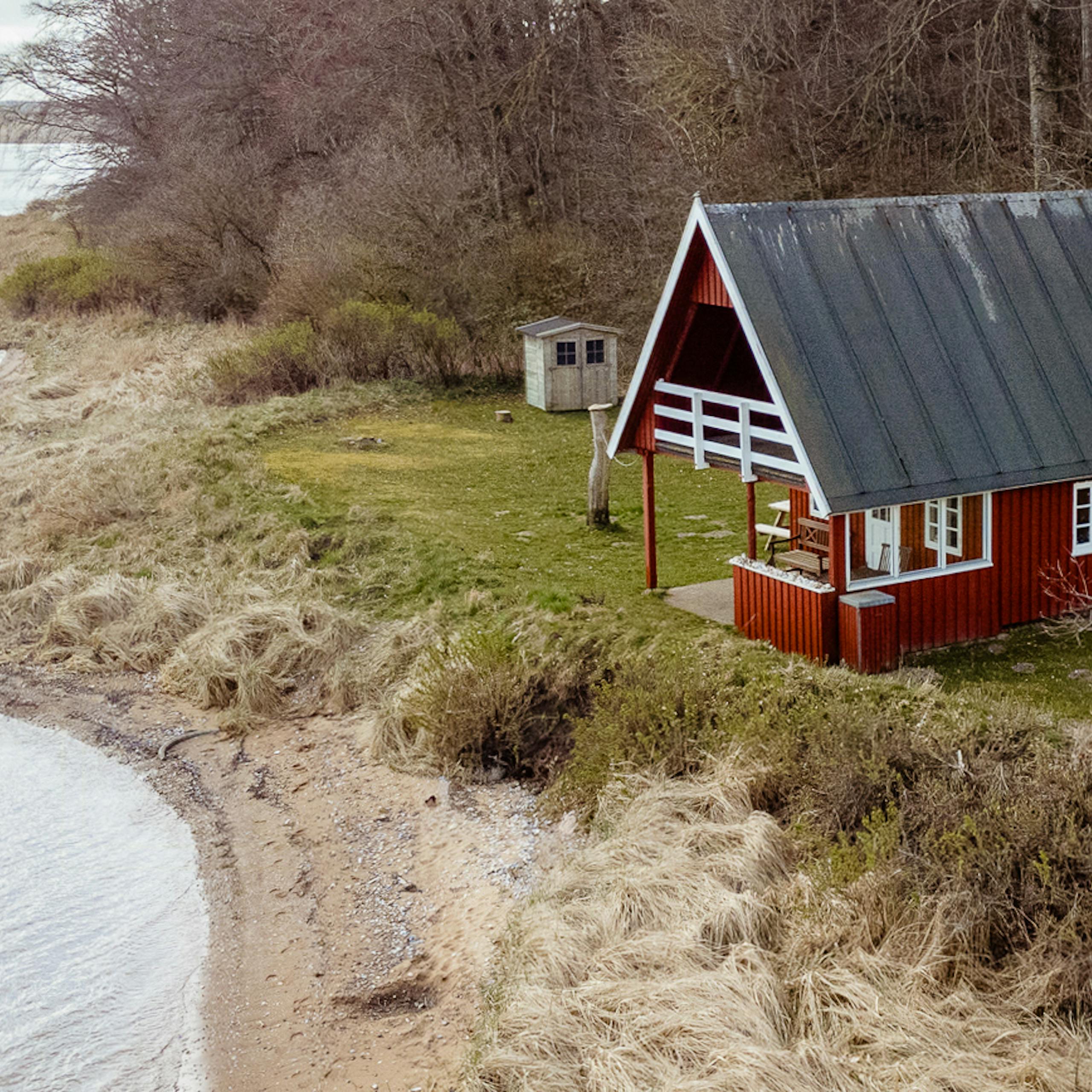
For Jesper and Manuela Basile, their wilderness bath became a sanctuary of well-being between demanding renovation work and a place where they could retreat, embraced by nature, amidst the renovation of their 1957 cabin.
Why did you choose to invest in a wilderness bath instead of all the other things you can invest in for your cabin?
“We did that because even though the cabin is old and we've kept the old style and it's not really supposed to be luxurious, I still needed it to be a place where you could retreat.” The small cabin is no more than 58 square meters, so for Manuela and Jesper, the wilderness bath became a kind of extension of the cabin Skoglys' space. “So you have a place where you can retreat, enjoy the peace, and just relax.”
“We chose to invest in it quite early. The renovation, which completely took over, meant we were completely exhausted after working for so many hours. After you'd been walking around all day tearing down roofs or whatever else we were doing, Jesper could light the tub in the evening. And just let all your muscles relax. All the tensions you have, they disappear when you sit in the warm water. So there's actually something good for the body in it too. It was incredibly lovely, and we also knew that when you come in afterwards, you're really tired, and then you get a really good night's sleep.”
So you have a place where you can retreat, enjoy the peace, and just relax.

“So it was also the idea that going to the cabin should feel like wellness. Along with the wilderness bath, we also ran an old-fashioned copper pipe out to an outdoor shower near the wilderness bath with hot and cold water and a real copper shower head with almost a rain shower, and we've built a nice shower screen. So we can stand and look at the trees when we shower before going into the wilderness bath. The idea of showering outdoors in nature even when it's freezing cold. Quickly under the water, put on your bathrobe, and sit in the wilderness bath at 38 degrees. That's well-being.”
We maintain it with chlorine-free maintenance. It's important for us to say, because the water ends up back in nature later.
When you arrive at Skovly, and you think “tonight we're going into the wilderness bath,” what do you do then?
“Practically, one of the first things I do is go over and fill the tub with water. If we're there for several weekends in a row, we fill it with water and maintain it with chlorine-free maintenance. It's important for us to say, because the water ends up back in nature later. But otherwise, I fill it, and I know approximately how long it takes. I set the timer on my phone, because if I go in on the sofa and have a cup of coffee and forget it, then it goes without saying that it will overflow.”
How long does it take to fill with water?
“It takes forty-five minutes for our 1200-liter wilderness bath.”
How do you light it?
“Once it's filled, you can light the stove. Just load it properly with wood. It needs to burn well. Give it plenty of air, and then it takes care of itself. I have a routine where I go over once every half hour and see if it's burning. Nothing is worse than promising your family an evening in the wilderness bath and then it's 9 o'clock and the water is only 20 degrees. I've tried that and it wasn't a success.”
How long does it take to light it?
“If it's 5 degrees below zero outside, it might take 2.5 hours. On a summer day, when it's naturally warm, it takes 1.5-2 hours. So you have to factor that in. But once you know that, it's not a problem. I've actually started lighting it a bit earlier. In the beginning, I'd look at the clock and estimate that it's 2 hours until 9, so now I have to go out and light it. Now I might light it in the middle of the afternoon, and then just let it die down a bit again. And then fire it up again half an hour before you're going into the bath. These are a couple of experiences that have taught me that you can just maintain the heat instead. It's actually easier to light it a bit hard at first, then let it die down a bit, and then maintain it. I can recommend that.”
So we can stand and look at the trees when we shower before going into the wilderness bath. The idea of showering outdoors in nature even when it's freezing cold. Quickly under the water, put on your bathrobe, and sit in the wilderness bath at 38 degrees. That's well-being.

It's a learning process, because there's no manual on how to do it. It's part of cabin life.
“It's a learning process, because there's no manual on how to do it. You have to try it out. It's part of cabin life. I'm a bit like, if it goes a bit wrong, we'll just try again tomorrow. And I've also tried firing it up so much that we had to change some water. We also always have a water hose lying over there, because when you get in and it's 38 degrees and you feel comfortable, there are often some embers that make the temperature a bit higher. That happens even to me, who has lit it 20 times before.”
Remember to consider fire hazard
“But also because of fire hazard. Our cabin is located in a place where we're not even allowed to have a fire pit in a plantation. So for purely safety reasons, we always have that. And you should always think about that when you get a wilderness bath, because it's live fire. So we always have a water hose lying around in case embers jump out when you open the stove door or something. We know there are 1200 liters of water in it, but we think it's a good insurance to have a water hose there. Also if it should go completely wrong. That you have at least thought about it.”
Why didn't you just choose a jacuzzi, where you can just turn it on and off with a button?
“It doesn't suit this old wooden cabin from 1957. It's actually quite simple. A real, square, lovely jacuzzi would also be great, but that's perhaps more for newer cabins. I think a wilderness bath just belongs with an old wooden cabin like this, located in nature. The two things just go together, I think.”
About Domantas Krumas and Vaido Vildmarksbad
The Danish family-owned wilderness bath company Vaido started in Lithuania, where Domantas Krumas and his father, and owner of Vaido, Vaidotas Krumas, originally come from. At the request of a family member, they built the first wilderness bath themselves in the garden, and slowly the business grew and new models were added to the selection. Today you can buy wilderness baths at vaidovildmarksbad.dk and visit their showroom in Tim on the West Coast of Denmark, where you can get advice and see the selection of different types of wilderness baths.*
When you describe the whole process you go through, Jesper, every time you light it, it sounds almost meditative and like a lovely tradition.
“It is too. Something as simple as sitting and watching the smoke rise from the chimney, that's pure meditation for me.”
How often do you use the wilderness bath?
“Every time we're here. Every time we're in a cabin, we go into the wilderness bath. For example, this week we went out to work from home at the cabin, and then we had some guests we also wanted to get ready for. And then we went into the wilderness bath yesterday, because we could. Being out there, when it's completely dark… even though it has all these functions, we rarely have either lights or bubbles in it. Instead, we just sit completely still in the wilderness bath and enjoy it. Both during the day and in the evening.”
A real, square, lovely jacuzzi would also be great, but that's perhaps more for newer cabins. I think a wilderness bath just belongs with an old wooden cabin like this, located in nature.
Choose the right wilderness bath for your cabin
The market for wilderness baths is large, and there are many different types to choose from. We've had a chat with Domantas from Vaido Vildmarksbad, who guides you on what you need to consider and what to be aware of if you're thinking of investing in a wilderness bath for your cabin. They've certainly noticed that wilderness baths at cabins have become popular: “In the past, people mostly bought wilderness baths for private gardens. But in the last two years, it has really blossomed in the cabin areas.”
Here's what you should consider before investing in a wilderness bath:
1. Go on a research trip and get an impression of wilderness baths first
Domantas advises you to go out and look at different wilderness baths before investing in one. This way, you'll get a good impression of both quality and types. “For example, we have a showroom in Thim, which many people appreciate, where you can come and see the product and see what quality it has,” he says.
Jesper and Manuela Basile found it advantageous to try a wilderness bath properly before investing in one. “You have to try it, I think, before you really know how lovely it is. So it's perhaps also an encouragement to try renting a cabin that has a wilderness bath if you're considering one,” says Manuela.


2. Choose appearance based on your cabin
Perhaps there's a specific atmosphere or feeling you want your wilderness bath to fit into. “We always start with what type of cabin you have. Many people like it when there's water massage in the wilderness bath and it fits the concept of the cabin. Some prefer to keep it a bit more standard. For example, if they have a wooden cabin, they might want to keep the wooden look, or some might want a specific color,” says Domantos.
And Manuela and Jesper Basile agree with that advice: “I think you should consider how you want it to look. That is, that it won't simply disturb. How will it fit with the rest? The plot the cabin is on, the way the cabin is built, and all those kinds of things. That would definitely be my advice.”

3. What is your space requirement?
One of the first things you should decide is how many people it needs to accommodate. “What do you want to achieve with the wilderness bath? Is it something the whole family will use, or is it just the two of us as parents?” says Domantos. You can make other decisions based on this.
4. Internal or external stove
A wilderness bath is heated by means of a stove either inside or outside the wilderness bath, which is lit and slowly heats the water in the tub. But how do you know which one to choose? According to Domantos, there are several things to consider:
“With an external stove, there's room for more people if, for example, you're a large family and want to sit together in it. Many, on the other hand, find an integrated stove more aesthetically pleasing, or that it's better because it takes up less space on the terrace,” explains Domantos.

Advantages and disadvantages of an integrated stove
“When it's a built-in stove, it means it's integrated into the wilderness bath itself. A typical model is about 2 meters in diameter and can accommodate 4-5 people. It holds 1000 liters of water and takes about an hour and a half to heat up. The advantage of an integrated stove is that where the stove is, two extra seats are created. So if you have small children, they can sit higher up, so they don't have to stand or you don't have to sit and hold them. If you get too hot yourself, you can sit there instead of sitting right on the edge, so you're still a bit under water and get some air.”
“If you'd like a bit more space, you can get a 225 model. That means the diameter of the wilderness bath is a bit larger. Then there's room for 6-8 people, while still being able to keep an integrated stove,” explains Domantos.
Number of people: 4-5
Water consumption: 1000 liters
Heating time: approx. 1.5 hours
Advantages and disadvantages of an external stove
“With an external stove, you get the space in the middle of the tub, so if you have a slightly larger family and need the space, that's typically where you choose an external stove. In terms of water, it's almost the same, so you don't think much about that. It takes about an hour and a half to two hours, then it's up to 40 degrees, or whatever temperature you want. Some people like it at 37-38 degrees, you decide yourself – how warm you want it,” says Domantas Krumas.
Number of people: 6+
Water consumption: 1000 liters
Heating time: approx. 1.5-2 hours
And you should also remember to consider whether you want to put anything in the water. This can affect what you need.
“There's a model called 304 stainless steel. That means it can only be used with chlorine or chlorine-free tablets. But sometimes people want to use saltwater or buy bath salts, which are good for the skin. Then you should choose an acid-resistant form.”
5. Wood, fiberglass, or acrylic
Many probably associate wilderness baths with traditional wooden tubs, where the water stands directly in the wooden tub. Today, you can buy wilderness baths in many different models, for example at Vaido, where the exterior cladding is wood and the tub itself is acrylic or fiberglass. Each type has different properties, explains Domantas Krumas:
“The acrylic model is something completely new for us, and it's a bit better than fiberglass. Fiberglass can get what's called fiberglass plague, just like regular fiberglass boats can get. These are millions of tiny bubbles that you can't do anything about. Acrylic is a bit better in that way, because it can't get this. And it's through-colored, so if there's a scratch in gray acrylic, it's gray underneath too. If it's a wilderness bath in gray fiberglass, the scratch will be visible, because it's only lacquered. So acrylic is a bit more resistant, so to speak.”
“And there are some colors you can choose, for example cream white, blue, or gray, if you choose fiberglass.”
“And then there are the models where it's just wooden wilderness baths. They're not as popular anymore, because when they're just made of wood and water is in them, they can warp, and that's work. That means that in the summer, wooden wilderness baths can dry out a bit. Then they become leaky, and you have to go and put sawdust in them. So there's more maintenance with a wooden wilderness bath than there is with these fiberglass or acrylic models.”

6. Maintenance of the wilderness bath
“When you choose a fiberglass or acrylic model, there's actually not much maintenance,” explains Domantas Krumas:
“The wooden cladding, which you can choose from us, is spruce or thermowood. Spruce is ordinary wood that is oiled or painted by us. But as I said, that means the wood can warp. So if it's summer and it gets dry, you have to tighten the tension bands. And you have to paint the spruce wood every year.”
“Thermowood is heat-treated wood, and that means it can't warp, it can't work. With us, it's oiled when you buy it, and then you don't need to oil it anymore, even if it's a family color. But if you want to freshen up the color, you can of course paint it in the color you want.”
7. Extra features
Once you have chosen a model, you can also choose whether you want the lid that comes as standard or if you want to buy what is called a thermal lid. There are some advantages to the thermal lid:
“We definitely recommend a thermal lid, because you can take it off alone. This means that if you are alone at the cabin and you need to light the wilderness bath, you can bend the lid up, feel the water, see if everything looks good. And when you are going to get in, you can actually pull it off yourself, or down into a stand that you can also buy, without having to struggle with it or hurt your back. A fiberglass lid, which typically comes as standard, always requires 2-3 people to lift it on and off. And it's unavoidable that you will scratch the edge a bit. You don't do that with a thermal lid.”
If you want bubbles in your wilderness bath, Domantas Krumas explains that there are two types; small air bubbles and a slightly harder water massage, which can help if you are sore in the body. If you choose water massage, electricity must be supplied to the wilderness bath, just as if you want light.
8. Cleaning and emptying water
Depending on the type of wilderness bath you choose, there will be different ways to clean it, explains Domantas Krumas:
“Fiberglass or acrylic models have a smooth surface. So that means that when you've emptied the water and you need to clean it, you just take a garden hose and a little Ajax or green soap, rinse it quickly, spray on soap, take a soft sponge, scrub it completely clean, and rinse it again. And then it's done, you now have a clean wilderness bath. That typically takes 10-15 minutes, and then it's done.”
“With wooden wilderness baths, it's a bit different. Because as I said, if it's working, you might have to put some chips in it. When you need to wash a wooden wilderness bath, you have to use a brush, and you have to get into all the joints and brush it hard because all the bacteria collect in there. So there's more maintenance with a wooden wilderness bath than with the new models with fiberglass and acrylic.”
And what do you do with the water, can you let it stand? There aren't necessarily purification systems in these wilderness baths, are there?
“Not necessarily, no. At Vaido, we recommend emptying the water every time you've used it. But that can seem very overwhelming, and they might think it's going to cost a lot of money. Then we encourage you to buy a sand filter or a ball filter that can stand and purify the water, and then you dose the amount of chlorine needed to keep the pH value in the right place. And then you can keep the water for 3-4 weeks at a time.”

9. Placement at the cabin
For Jesper and Manuela Basile, the location of the wilderness bath at the cabin has been absolutely crucial:
“It has meant an incredible amount that we placed it where it is today, because you really want to go there – because it's so peaceful there. I think if I had pushed through that it should be on the terrace, we wouldn't use it as we do today. So that thing about lying and looking around, taking a walk on the property, feeling what feels best, and then leaving it there a couple of times you're there. So finding the absolutely right location for the wilderness bath is actually the number one piece of advice I want to pass on.”
And there are a couple of other practical things to remember, says Domantas Krumas:
It must be completely flat
“The wilderness bath must be completely flat. So if you don't have a terrace or tiles where it can stand, you need to make sure the surface is completely flat before you buy the wilderness bath. It must stand on a firm, completely flat surface. Of course, you also need to have thought about a water hose that you can reach. If you have electricity in the wilderness bath, for example for lights or massage bubbles, you also need to have electricity run there.”
Consider the wind
“And you should also think a bit about what the wind is like at the cabin, because we have a lot of wind from the west. We always recommend placing the chimney away from the wind, so that when you're sitting in the wilderness bath and you're firing it up, you don't get the smoke blown down into it, but rather blown away from you.”
Can you actually move a wilderness bath after you've placed it?
“A wilderness bath typically weighs 200-250 kg, so four or five men can easily move it around. It also doesn't harm the wilderness bath if it's first placed in one spot and then moved to another. That's perfectly fine,” says Domantas Krumas.
10. Price example
I have a fantastic, old cabin from the 70s that looks pretty much the same as it did in the 70s. And there, I think I'd prefer a wilderness bath that doesn't require any electricity. But it should be relatively easy to maintain and have space for 6 people.
“A model like the one you're looking for could be a fiberglass model with a 225 diameter, a thermal lid, thermowood, and an integrated stove in 316 acid-resistant steel, a two-meter chimney with protection, stairs insulated with foam, with a shelf for drinks, and of course, it's on a galvanized steel base, not wood. For that, we have a price of 27,500 including VAT, shipping, and setup.”
And if you don't want the largest model with space for 6-8 adults, what would that cost?
“Then you usually say minus 2,500 kroner,” says Domantas Krumas.

Do you want to experience Jesper and Manuela's beautiful cabin and wilderness bath yourself? Book a stay at Skovly here.



Written by Nina Lykke
April 2023
