Making the Cabin Dream a Reality: The Bank Advisor's Best Advice for Buying a Cabin Step-by-Step

Karen Laursen, Head of Private Banking at Danish Merkur, guides you through the process of buying a cabin, from start to finish, and what you should consider before purchasing. Also, read about the most important financial experiences from Thomas Gustav Hedegaard, who invested in his own cabin at the age of 23. The information in this article is based on Danish conditions and regulations, so remember to speak with your bank advisor to ensure you know everything you need to know when buying a cabin in Norway.
Would you rather listen to the episode? Listen to the episode with Karen Laursen and Thomas Gustav Hedegaard from our podcast SOMMERHUSLIV here or wherever you listen to podcasts.
At Landfolk, we are cabin enthusiasts with a capital C, and we know that many Norwegians dream of becoming cabin owners. But where do you start when trying to figure out if buying a cabin is a good financial choice? How much can you afford it to cost? What things do you need to include in your budget?

No posts on Landfolk.com are sponsored or otherwise supported by companies mentioned in interviews or other articles. The interviewed individuals participate solely based on their expert knowledge or experience.
That's why we've spoken with Karen Laursen, Head of Private Banking at Danish Merkur Andelskasse, and Thomas Gustav Hedegaard, who recently became a cabin owner in Denmark, about how you should proceed if you want to buy a cabin – from start to finish, and what you should be aware of before purchasing.
The information in this article is based on Danish conditions and regulations, so remember to speak with your bank advisor to ensure you know everything you need to know when buying a cabin in Norway.
A way to enter the housing market
There are many ways – and reasons – to buy a cabin. For 23-year-old Thomas Gustav Hedegaard, buying a plot of land on Djursland in Denmark and building a cabin on it wasn't just a dream of a cabin. As a young person studying to become a carpenter, he didn't have much money left in his budget to spend, but from his job and education, he could see that renovating properties could be beneficial.
“The romantic idea is that I sat in my apartment in Aarhus and imagined a cabin and thought: how do I make that happen? But it was actually about more than money when it came to what determined that the cabin was a project within my reach.”
So perhaps it was the dream of real estate that turned into a dream of a cabin
“I didn't have the finances to enter the market with an apartment or anything near Aarhus. So what could I actually afford? We had built a large allotment garden, almost a cabin, and there I could see that it cost around 300,000 Danish kroner in materials. So maybe I could find a plot of land that matched some of the budget I had left over.”
Thomas Gustav Hedegaard then sat down and did some calculations that gave him between 500,000 and 600,000 Danish kroner to play with. He wouldn't be able to buy an apartment for that amount, but he would be able to find a plot of land for a couple of hundred thousand.
“And then I could see that there was actually room in the budget for me to be able to build a house on that plot. And suddenly, I would be able to make a good deal that way. So perhaps it was the dream of real estate that turned into a dream of a cabin, because that's what became possible in that situation. But it's also exclusively possible because I can see a future where I can rent out the cabin and thereby cover some of the expenses.”

How to know if buying a cabin is a good idea for you But how do you know if buying a cabin is a good idea for you specifically? Karen Laursen says that for many it can be a good idea, but of course not for others – and that you really need to think carefully before jumping into buying a cabin.
“It's easy to walk around beautiful cabin areas and fall in love with one charming cabin after another, but fundamentally, you have to start by figuring out what your financial framework will be, based on your current finances. How much can you spend on this in your monthly budget? And then you have to try to calculate backwards a bit and see what type of cabin it would then be possible to buy,” she explains.
If you have to borrow a million, it costs approximately 6,000 Danish kroner just for that every month.
“We have a lot of customers who are concentrated around the big cities, and they naturally want to get out into the countryside sometimes for some fresh air. But what you need to consider if you invest in a cabin is that you have to set aside approximately 8,000-10,000 kroner depending on how much you have saved before buying, so that's 8,000-10,000 kroner more every month in fixed expenses. But of course, it depends on how expensive the cabin you buy is, and what fixed expenses are associated with it. But if you have to borrow a million, it costs around 6,000 Danish kroner just for that per month. And then there's water, heating, property taxes, and various expenses that belong to the operation of a cabin.”
If you calculate that you don't have at least 8,000-10,000 kroner left in your budget each month, it's a sign that buying a cabin might not be within reach right now. If, on the other hand, you have a bit more room in your budget, you can proceed with the cabin dream step-by-step in this way, says Karen Laursen:
1. Calculate how much you have left in your budget and test it
“If you are considering investing in a cabin, I would start by calculating how much you have left in your budget today. How much money are you used to spending? Are you saving anything? As a general rule, a family of two adults and two children should have 17,000 kroner left each month for food, clothes, activities, and other pleasant things. What you have left on top of this is, in principle, funds you can invest or spend on a cabin,” explains Karen Laursen.
Now we set this money aside, 8,000 kroner every month. We put it into an account and then we see how it goes for about half a year. How would everyday life be if we also had a cabin? That's one of the financial tests you should do.
However, there's a catch, she says:
“If you have a standard of living that means you spend all your money every month, whether you have 28,000, 29,000, or 30,000 kroner left each month, then you have to prove for a period that you can actually live on less than the amount you have left.”
Therefore, she suggests testing having less left over for a period, as if you already own a cabin:
“Now we set this money aside, 8,000 kroner every month. We put it into an account and then we see how it goes for about half a year. How would everyday life be if we also had a cabin? That's one of the financial tests you should do. You can always take that money out if you end up feeling that it would be a bit too tight.”
And then she suggests trying out the lifestyle before making such a large investment as buying a cabin.
“Apart from doing this test with your finances, I also think you should, for a period, test going on cabin trips for all your holidays, if that's what you're focusing your finances on. If the intention is that for many years to come you will go to the cabin instead of traveling abroad. Maybe you can borrow one, and if not, you can rent one.”

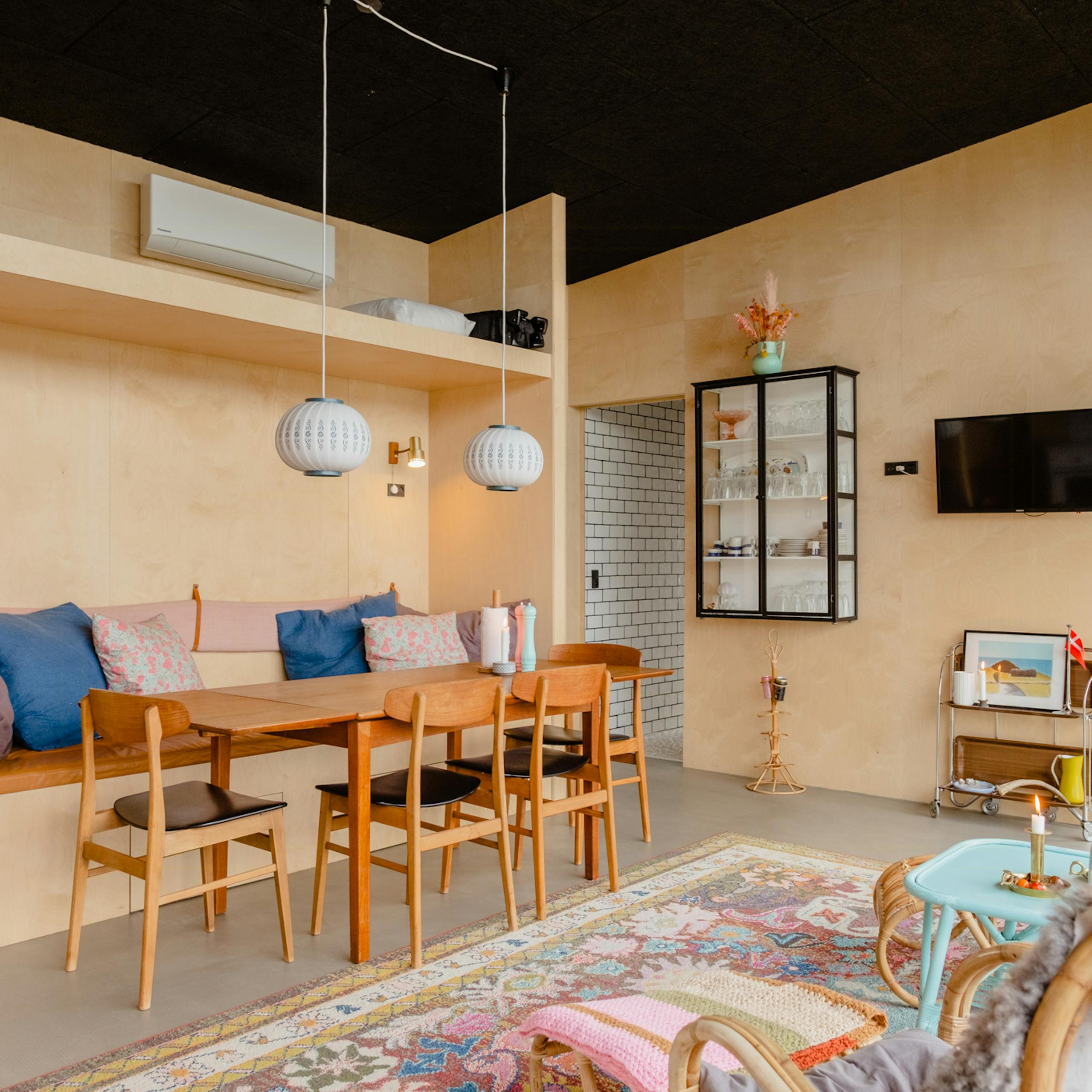
Become one with nature in "Oldes Hytte"
- Salling, Denmark
- 4 guests · 2 bedrooms
- 439 m to beach
- House · 47 m²
2. What price range can I afford?
Once you have calculated how much you have left in your budget each month, you can start calculating the other way and see what price range you can afford to look for.
If you buy a year-round home, you will typically be able to borrow 80 percent of the price, but with a cabin, you can borrow up to 75 percent of the value, says Karen Laursen.
“You can also get the last part of the cabin financed, but most people choose to finance the 75 percent with a mortgage loan, in addition to what they have saved themselves. It will typically be an advantage to do so, as it will typically be cheaper to do it through a credit association. Of course, it will also be an individual assessment, because some have an equity share if they own real estate initially. So if you have equity in your own home, it might be possible to do something this way.”
If you borrow through a credit association when borrowing money to buy a cabin, they will often want to assess the cabin themselves, explains Karen Laursen.
“That's because the sales price is typically an assessment the real estate agent has set based on buyers making the best possible deal. But typically, the cabin will be valued at the agreed-upon transaction price. If there is a large difference between these two figures, you will be notified by us. We have a collaboration with TotalKredit, so their appraiser will give us feedback that we might not be able to lend money at that price,” she says.
3. This is what you should include in your calculations when looking for a cabin
“What type of cabin you should choose depends entirely on what the cabin will be used for,” says Karen Laursen. But there are still a few things to consider:
“I think you should consider the location, and then of course compare the average price per square meter in the areas you are looking for a cabin. Cabin prices have only decreased by 7-8 percent on average nationwide, so they haven't experienced a particularly large drop. And then you should look at how long they have been on the market when they are for sale. In the area where I had a cabin before corona, cabins were for sale for two to three years before they were sold. That's a long time to take care of a cabin you're no longer very interested in.”
According to Karen Laursen, it's a good idea to consider the following elements when looking for a cabin:
1. Location
2. Price per square meter – compare the price per square meter in the areas you are looking.
3. Time on market – how long have cabins in the area been for sale on average? Even if you think you'll have the cabin forever, it's a good idea to keep this in mind if you potentially end up with expenses for a cabin for several years after you actually wanted to sell it.
4. Property taxes – which can be more expensive in the most attractive cabin areas compared to other places in the country. You will always be clearly informed about this before you buy.
5. Costs for water, heating, and electricity
6. Cabin insurance
7. Sewage – in some cabin areas, the sewage system is soon so old that it needs to be replaced. Check the local plans in the area and the homeowners' associations to see if there's a potential expense there.
8. Natural conditions of the area – a cabin by the sea requires different maintenance than a cabin in the mountains, so consider what the cabin will need based on the area it is located in.
9. Other operating and maintenance expenses
10. Rental history – if the cabin has been rented out before, you can check the history for the last three years and add 75% of that rental income to your income. This increases the surplus in your budget, and you will be able to afford a more expensive cabin. If it hasn't been rented out before, you can get an estimate from the history of similar cabins from a rental company.
In addition, Thomas Gustav Hedegaard emphasizes the importance of really thinking through what expenses can influence how much money you have left each month when embracing the cabin lifestyle:
“If you plan to renovate and build yourself, it's important to think about, for example, transportation costs to and from the cabin. I hadn't thought of that. It required me to have a car with fuel and insurance,” he says.
“And then there are various expenses for the bank. That's money that doesn't necessarily come back in any way. That ended up being perhaps 15,000 kroner, where I had to watch it end up in other people's pockets. That's fair, because they take a risk by lending me the money, but those were expenses that are not part of the investments I make by building.”
4. Check the cabin's rental history
When you buy a cabin that has been rented out before, you will usually be able to see what the rental income has been for the last three years. And that matters for your loan:
“You can take 75 percent of this rental income and add it to the amount you have left in your budget each month. So that means you will be able to buy a more expensive cabin, because the amount you have left will be positively affected by this rental income.”
All of this is to take the best possible care of you and your finances, so that you don't end up with too tight finances in the long run. It should be a good experience to have a cabin.
“If you have fallen in love with a cabin that has not been rented out before, it is often possible to get help,” says Karen Laursen. “Talk to a rental company and see if they can give you an estimate of what a similar cabin of the same size with the same number of sleeping places could generate in rental income. How much would you need to rent out the cabin and what would the price typically be per week? Although the estimate can be used as a kind of documentation, the bank will still be more cautious than if the cabin itself had a history in this regard,” says Karen Laursen.
“All of this is to take the best possible care of you and your finances, so that you don't end up with too tight finances in the long run. It should be a good experience to have a cabin.”


Family home in heather-clad landscape
- Svinkløv Plantage, Denmark
- 6 guests · 3 bedrooms
- 103 m to beach
- House · 89 m²
5. “That stupid bank, how do I trick them?”
That the bank would also consider his finances was not one of the first things Thomas Gustav Hedegaard thought about when he was going to borrow money for a cabin.
“Before I was allowed to borrow money, and before the first dialogues I had with my bank, I actually think I was a little afraid of the bank. But you have to remember that they are teammates in that situation. And there I think I sometimes sat at home and thought, that stupid bank, how do I trick them into lending me a little more. The whole process of being able to have a good dialogue with your bank is something I think was important for me to learn, that the bank actually worked for me in that situation,” he says.
6. Choose solutions that make it possible to sell the cabin again
Part of becoming financially dependent on a cabin also involves considering the possibility that one's life situation and the amount of extra money in the budget may change. Therefore, it is important to be able to get rid of the cabin again if it becomes necessary, and this is something Thomas Gustav Hedegaard has thought a lot about.
“The bank told me that the quality of what was built should be at a level that made it possible to sell again. No matter how deep my intentions were to keep it forever, it shouldn't become too peculiar a cabin that only I would appreciate,” he says.
Nevertheless, I end up making choices throughout the entire building process, where I question whether it's just me who sees the value in the solutions I choose.
He has built his own cabin while training as a carpenter, and with a student's budget, it was extra important to make wise financial choices. At the same time, as a carpenter, he has a love for quality and good craftsmanship.
“It's going to sound like the intention is to sell the cabin, and it's not. Nevertheless, I end up making choices throughout the entire building process, where I question whether it's just me who sees the value in the solutions I choose. If I suddenly spend many hours laying a floor, could it just as well have been a cheap plastic floor that would be easier to maintain and rent out? There I have judged that it is worth the time and money, just because it is worth something to me in these situations,” he says.
“In those situations, I can't figure out if economics and awareness of rental value should be so much in focus. But those are the interesting choices – especially when I know that I've been right on the verge of being allowed to borrow money with relatively little left in my budget each month.”

Some of what has made it possible for him to create high-quality solutions that were still budget-friendly has been to search online for good finds – and be prepared to strike:
“Windows with wrong measurements, used doors, and used flooring in beautiful materials, I wouldn't have wanted to be without them, but they have also been cheaper than if I had bought them new. And there you can risk finding five patio doors that fit the cabin perfectly at a somewhat inconvenient time. Having that expense of perhaps 500-600 kroner a month for a small storage room can save you a lot of money in the long run. That's a place where you can find some more money in a building process,” he says.
No matter how deep my intentions were to keep it forever, it shouldn't become too peculiar a cabin that only I would appreciate
The best places to make these finds, according to Thomas Gustav Hedegaard, are Laurits.com, Finn, Facebook Marketplace, or Facebook groups, where you can find building materials and used items.
“In periods, I've almost looked at these sites daily, because I knew that it had to be the same model of windows throughout the cabin. Then I could use my break to write to them to see if I could buy them. So, for example, I drive to Haderslev after work to pick up just one window, because it was the right color and only cost 500 kroner, and might cost 3,000-4,000-5,000 kroner new. So it's just about being on it all the time, because the good deals disappear.”


Written by Nina Lykke
April 2023
